

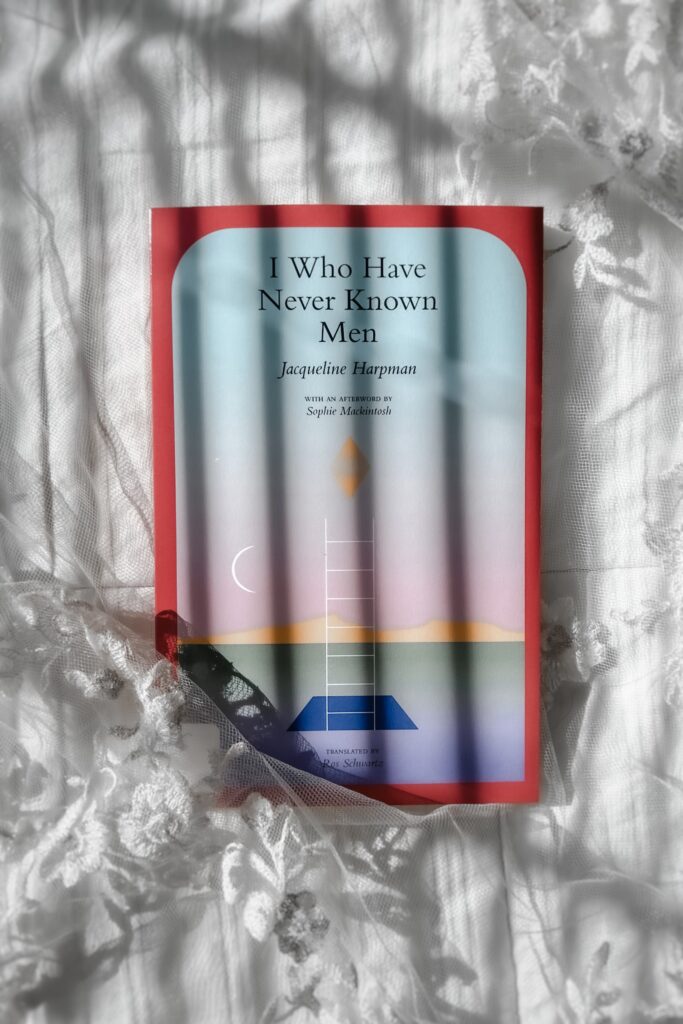
I don’t even know where to start with this one. I finished I Who Have Never Known Men and then just sat there, staring off into space. It left me with that heavy, unsettled feeling where you’re not sure what you just experienced, but you know it has to mean something. Right?
I tend to take notes while I read, but this time I didn’t have much of anything at all to look back on. It was a short read, for one thing, but for another thing, I felt so unsure the entire time to even write something down.
This post could contain affiliate links, which means I would receive a small commission at no cost to you should you shop using the links.
The book kept me guessing nonstop. And yet, it never offers any answers.
Not about the world, not about the guards, not about the cage, or the reason any of this is happening. You’re just dropped into the unknown and left to sit with it and accept it.
That’s the whole experience. Sitting in the unknown.
And somehow, that’s what makes it so effective.
I cannot mourn for what I have not known.
Jacqueline Harpman, I Who Have Never Known Men
While reading, I realized I had no real personal take on any of it. I kept trying to imagine myself in the main character’s place. What would I do, what would I feel… but it’s nearly impossible to answer.
I know this life. I know love, friendship, family, the chaos and comfort of a “normal” world.
The narrator doesn’t. She’s never had it, never lost it, never known to want it. That absence shaped everything about her. I couldn’t stop thinking about that.
Never Known Beauty
And then there was this other lingering thought I had while reading: image. Or more specifically, the complete lack of it.
These women don’t have mirrors. The older ones might remember their appearance from their life before whatever this is, but even those memories are decades old. But the girl? She has no idea what she looks like.
The narrator doesn’t know beauty, not in the way we define it. She doesn’t know what she looks like. She has no filter for how she’s perceived. And somehow, that felt both freeing and deeply, deeply sad.
Being beautiful, was that for men? I could have loved myself whether I was hunchbacked or lame, but to be loved by others, you had to be beautiful.
Jacqueline Harpman, I Who Have Never Known Men
Something else that stuck with me was how little fear the girl seemed to have. The older women had lived lives before this, so they knew what they’d lost. They knew danger. But the girl? Her detachment, her ability to survive without being ruled by emotion, almost made her feel superhuman.
Or maybe, that’s just what happens when you’ve truly never known men.
Everything We Know
But then there’s this: the men were guarding them… but from what? If men are women’s biggest threat, what could possibly be so dangerous that it requires the men to guard the women? It left me spiraling a little, to say the least.
The power dynamics, the control, the ambiguity! It all circles back to the same disturbing question: Why were they there at all?
I was forced to acknowledge too late, much too late, that I too had loved, that I was capable of suffering, and that I was human after all.
Jacqueline Harpman, I Who Have Never Known Men
This isn’t the kind of book that wraps up neatly. It doesn’t hand you a lesson. It lingers, making you question what it means to be human, what we carry with us, and what we become when we’re stripped of everything we’ve ever known.
Even now, I’m not sure what else to say.
But maybe that’s the point.
We’re not supposed to have answers.
Just like these women, we’re dropped into a world we don’t understand, and we’re left to survive in it. We sit in the unknown because that’s what they’ve been forced to do! To live in a state of permanent unknowing.
It’s not just unsettling.
It’s intentional.
